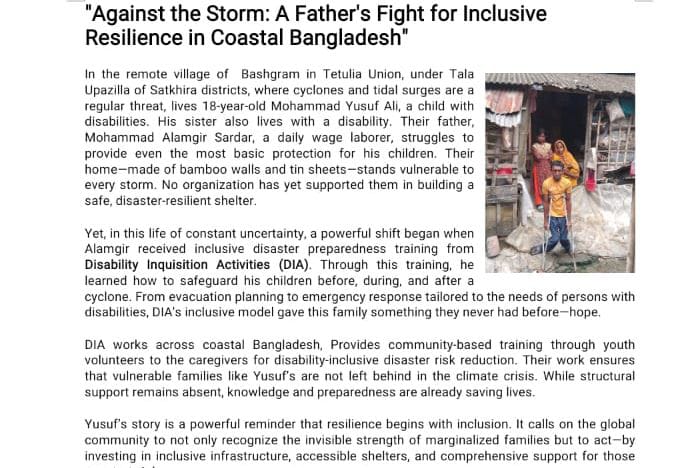
In the remote village of Bashgram in Tetulia Union, under Tala Upazilla of
Satkhira districts, where cyclones and tidal surges are a regular threat,
lives 18-year-old Mohammad Yusuf Ali, a child with disabilities. His sister
also lives with a disability. Their father, Mohammad Alamgir Sardar, a
daily wage laborer, struggles to provide even the most basic protection
for his children. Their home—made of bamboo walls and tin
sheets—stands vulnerable to every storm. No organization has yet
supported them in building a safe, disaster-resilient shelter.
Yet, in this life of constant uncertainty, a powerful shift began when
Alamgir received inclusive disaster preparedness training from Disability
Inquisition Activities (DIA). Through this training, he learned how to
safeguard his children before, during, and after a cyclone. From
evacuation planning to emergency response tailored to the needs of
persons with disabilities, DIA’s inclusive model gave this family something they never had before—hope.
DIA works across coastal Bangladesh, Provides community-based training through youth volunteers to
the caregivers for disability-inclusive disaster risk reduction. Their work ensures that vulnerable families
like Yusuf’s are not left behind in the climate crisis. While structural support remains absent, knowledge
and preparedness are already saving lives.
Yusuf’s story is a powerful reminder that resilience begins with inclusion. It calls on the global
community to not only recognize the invisible strength of marginalized families but to act—by investing
in inclusive infrastructure, accessible shelters, and comprehensive support for those most at risk.